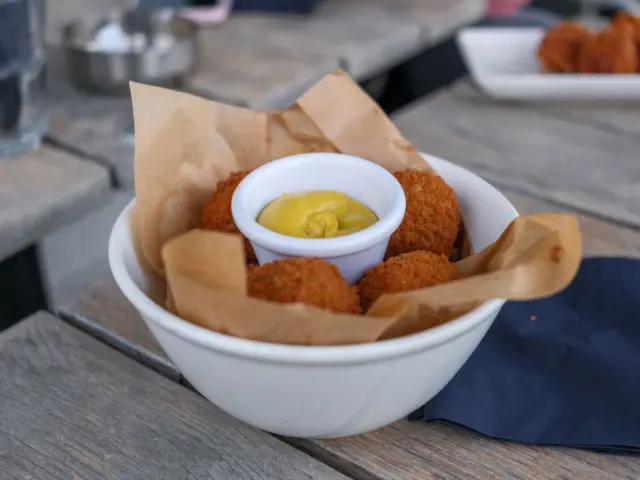
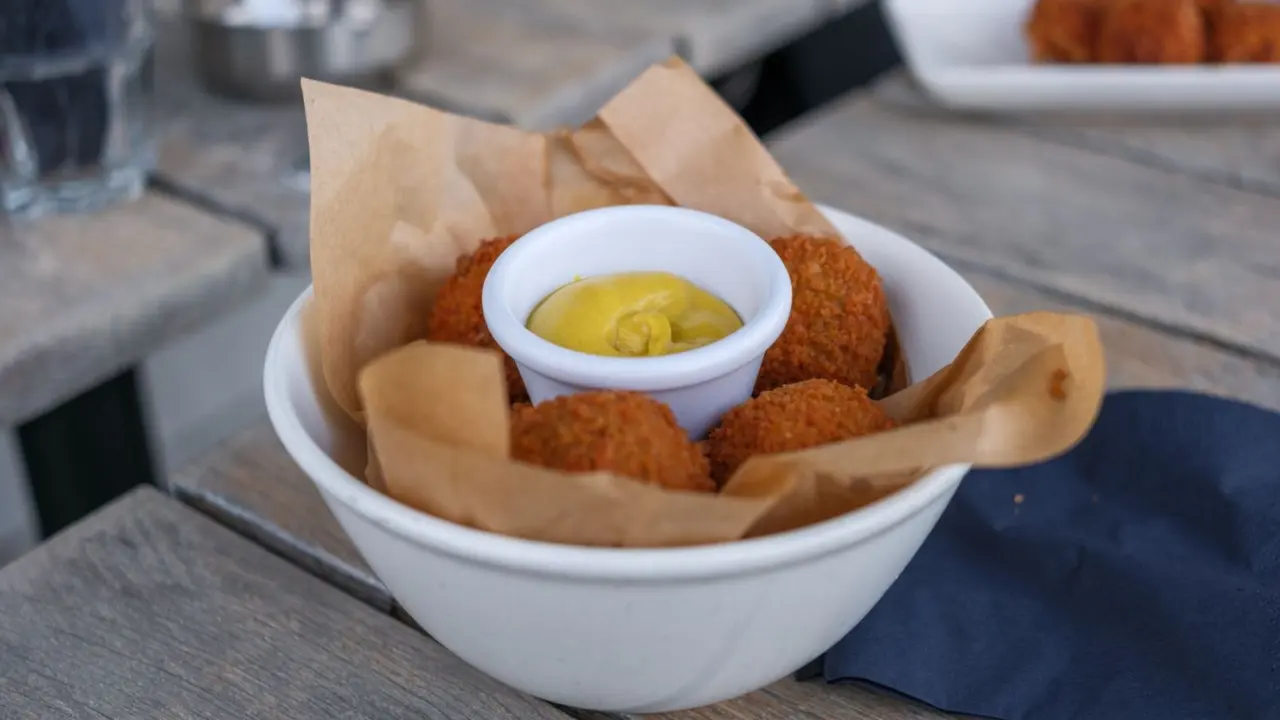
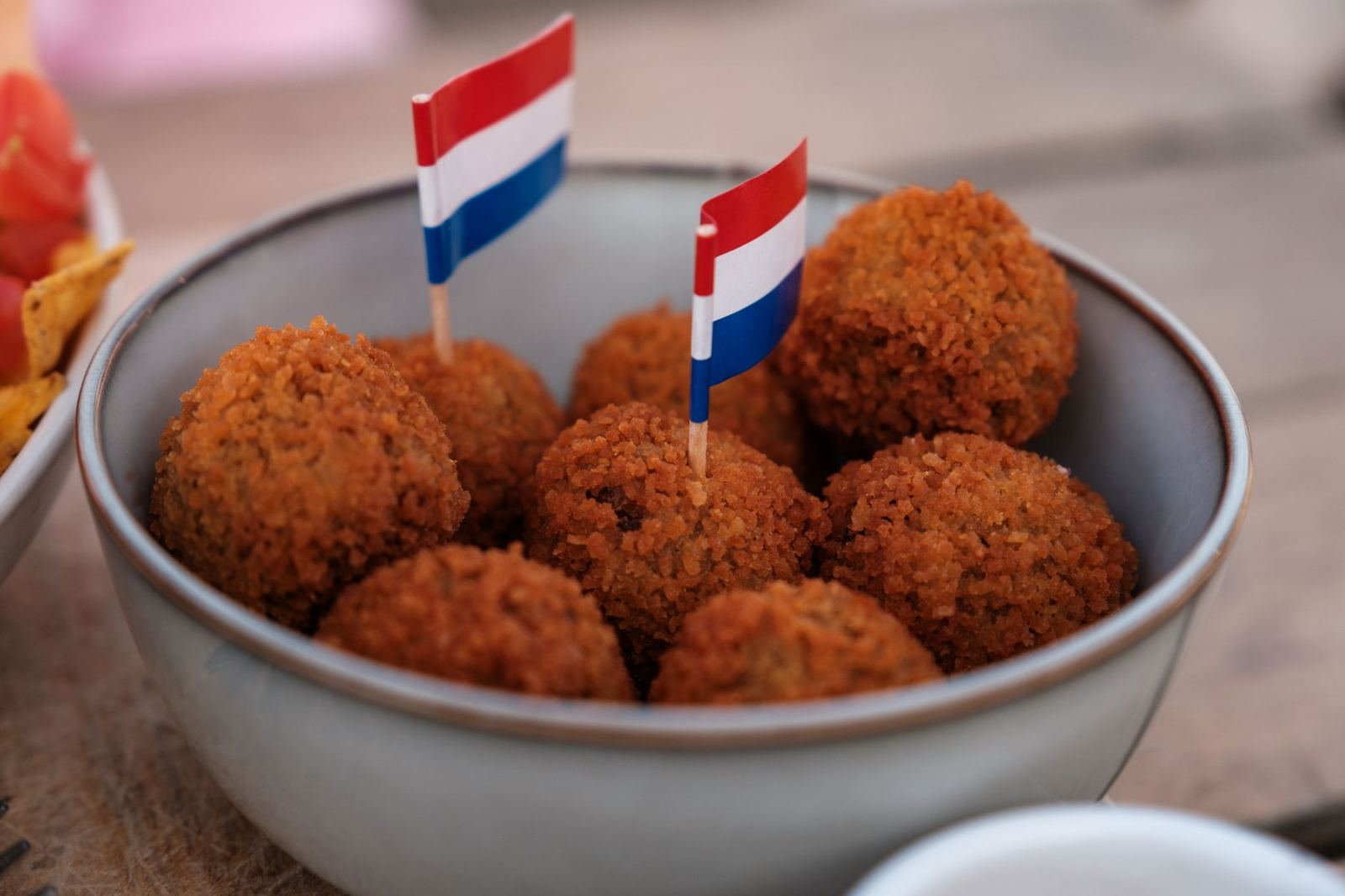
Wondering what to order with your beer in a Dutch pub? Bitterballen are crisp, breaded balls filled with a thick, meaty ragout, served hot with mustard. Order them as a shared snack with drinks.
Bitterballen are one of many snacks and dishes covered in the guide to dutch food.
| Item | Value |
|---|---|
| Place of origin | Netherlands |
| Typical diameter | Roughly 3 to 4 cm |
| Serving temperature | Hot, with mustard |
| Frying oil temperature | 180 °C (355 °F) |
| Yield of one home recipe | 30 to 50 bitterballen |
These figures come from Wikipedia’s bitterballen entry and Coquinaria’s kroket recipe. They can change or vary by cook, so check the source before you rely on them.
What are bitterballen?
Bitterballen (the singular is bitterbal) are a Dutch meat-based snack. Cooks make a very thick stew with roux and beef stock, chill it until it firms, roll it into balls, then bread and fry them.
The base is a ragout, and the usual ingredients are:
- beef or veal, minced or chopped
- beef broth
- butter and flour for the roux
- parsley, salt and pepper
- onions and nutmeg as seasoning
The snack is mostly eaten in the Netherlands, Belgium, Suriname and Bonaire, and to some degree in Indonesia. The inside is soft and creamy, not a firm meatball.
Where does the name come from?
The name does not mean the snack tastes bitter. It comes from the herb-flavoured alcoholic drinks called bitters in Dutch that the snack was traditionally served with.
Coquinaria adds that bitterballen were originally meant to go with a bittertje, a small glass of Dutch jenever. The word bal simply describes the round shape.
One popular retelling credits Spanish cooks during the Eighty Years’ War, which that account dates to 1568. That origin story comes from a lifestyle article, and Wikipedia lists the Netherlands as the place of origin, so treat the tale as a story rather than settled history. You can read it in IamExpat’s short history of the bitterbal.
Today the most common drink at a Dutch borrel, an after-work drinks gathering, is beer. You will rarely see a bittertje alongside the snack unless you ask for one.
How bitterballen are made
The method is the same as for a kroket, only smaller. The ragout does the work, so it has to be thick and well filled.
- Cook a roux of butter and flour, then add stock and finely chopped cooked meat.
- Chill the ragout until it is completely firm.
- Roll the filling into balls roughly 3 to 4 cm across, as Wikipedia describes.
- Coat each ball in flour, then egg, then breadcrumbs, covering it all over.
- Deep-fry in oil at 180 °C (355 °F) until golden, as in Coquinaria’s recipe.
Coverage matters because, in Coquinaria’s words, a gap lets the ragout leak out during frying. Keeping the balls cold also makes them easier to bread.
Stefan’s Gourmet Blog, which adapts a pastry chef’s recipe, uses a double breading: fine crumbs for the first layer and coarse crumbs for the outer one. It says a mixture of egg whites and flour helps stop the balls from leaking. You can read the full method on Stefan’s Gourmet Blog.
How to serve and eat bitterballen
In the Netherlands, bitterballen often arrive as part of a bittergarnituur, a selection of savoury snacks to go with drinks. You will find it at pubs and at receptions.
The usual setup is simple:
- a ramekin or small bowl of mustard for dipping
- toothpicks for picking up the balls
- a drink, most often beer
Serve them hot, but give each one a moment first. Coquinaria jokes about a formally dressed guest trying to eat a still too hot bitterbal while holding a glass of champagne, so bite carefully.
If you want a brunch-style Dutch plate to sit beside the snacks, try the uitsmijter recipe. Cheese fans planning a drinks table can read about the types of dutch cheese.
Bitterballen versus kroketten
Bitterballen are very similar to the more common kroket in ingredients, preparation, cooking method and flavour. The difference is the shape: kroketten are oblong and sausage-like, with a similar diameter.
The two tend to turn up in different places:
- Bitterballen: bar snack and finger food at stand-up receptions.
- Kroketten: a popular lunchtime snack on a soft bun, known as a broodje kroket.
Both are made from a ragout that has firmed up in the refrigerator before breading and deep-frying. If you can make one, you can make the other.
Variations and what to look for
The ragout can be varied in many ways, according to Coquinaria. The main ingredient, herbs, liquid and extras such as mushrooms can all change, and its rule of thumb is that sauce plus stuffing makes ragout.
Coquinaria lists a few kroket variations that work the same way:
- cheese, made with milk in the roux instead of meat
- fish, made with fish fumet and herbs like dill or chives
- vegetable, made with a blond roux and blanched vegetables
Not every ragout suits every filling. Coquinaria notes that game kroketten use a brown roux, and that mushroom kroketten are better with a ragout made with meat stock or the liquid the dried mushrooms were steeped in. These are kroket recipes, but the same ragout logic applies to the smaller round balls.
Whatever the filling, Coquinaria says the ragout must be richly stuffed and thickened more than an ordinary ragout. That thick texture is what lets it firm up in the refrigerator so you can roll it.
Size matters too. Coquinaria warns against making them too large, because they then have to be deep-fried for too long. Bitterballen are already the small version, so keep each ball modest.
Quality varies when you buy them. Stefan’s Gourmet Blog says poor-quality bitterballen in the Netherlands are made from horse meat and/or mechanically separated meat, while high-quality ones contain pieces of meat. The same blogger prefers a flaky texture where the meat is blended into the ragout, which shows that texture is partly a matter of taste.
A few checks help whether you are buying or cooking:
- Read the label for the type of meat used.
- Decide whether you prefer visible pieces of meat or a flaky, blended ragout.
- Keep the balls small so they fry evenly and do not need long in the oil.
Making your own is a way to control what goes in. Stefan’s Gourmet Blog says it is worth making them from scratch even in the Netherlands, because you can make them to your liking and control what goes into them. One home recipe yields 30 to 50 bitterballen, so you can freeze the extra ragout, as Coquinaria suggests for the ragout.
Home cooks have plenty of room to experiment as well. IamExpat notes that there are tonnes of recipes which put their own twist on the bitterbal and its fillings.
Frequently asked questions
Are bitterballen made with beef?
Show answer
Usually, yes. Wikipedia lists beef or veal, beef broth, butter and flour as the main ingredients, but cooks vary the filling.
Why are they called bitterballen if they are not bitter?
Show answer
The name comes from bitters, the herb-flavoured alcoholic drinks they were traditionally served with. Bal refers to the round shape.
What do you eat bitterballen with?
Show answer
Mustard is the classic accompaniment. They are typically served with a small bowl of mustard for dipping, along with toothpicks.
Are bitterballen the same as kroketten?
Show answer
They are very close in ingredients and flavour. Kroketten are larger and oblong, while bitterballen are round.